
Understanding the Federal Reserve: A Guide for Homebuyers and Homeowners
You've probably heard the news: 'The Fed raised rates.' Or 'The Fed is holding steady.' Or 'Markets are watching the Fed's next move.'
But what does any of that actually mean for you? And why should someone buying a house care what a committee of economists decided in Washington?
You don't need an economics degree to understand how this affects your home loan. Here's what actually matters.
What Is the Federal Reserve?
The Federal Reserve, usually just called 'the Fed,' is the central bank of the United States. Your bank has a bank. That's the Fed.
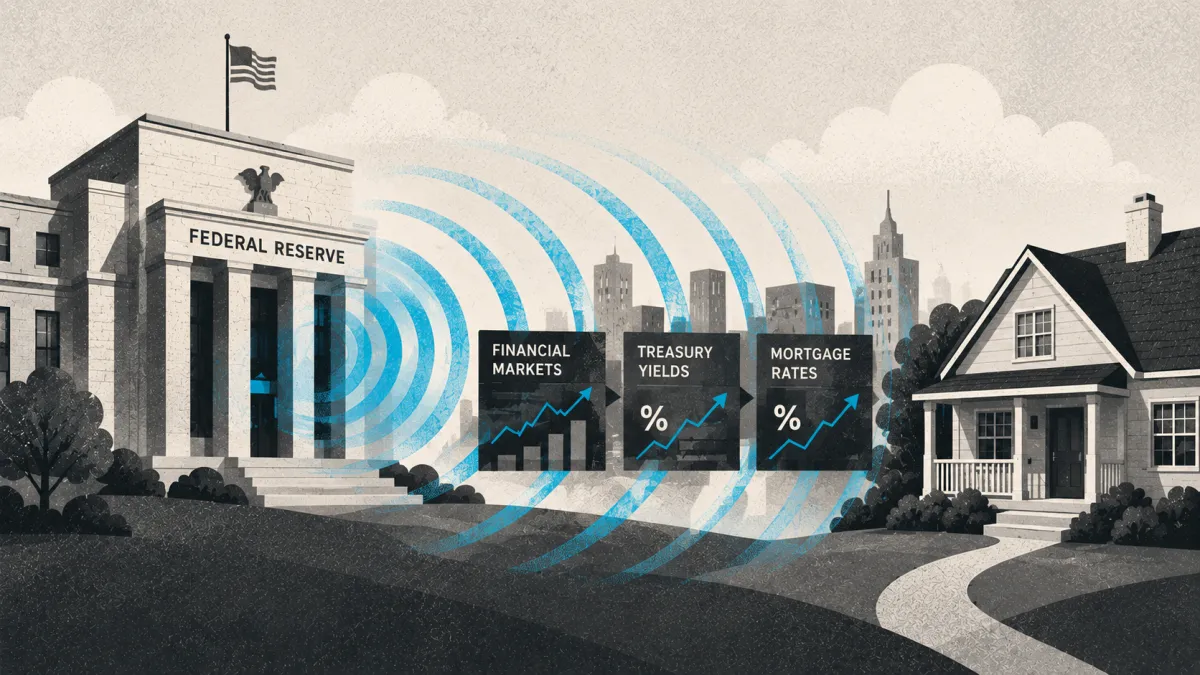
It doesn't give you a mortgage. It doesn't have branches you can walk into. But the decisions it makes ripple through the entire economy, including the interest rate on your home loan.
The Fed was created in 1913 to keep the U.S. financial system stable. Today its main job is a balancing act: keep the economy growing without letting inflation get out of control. It does that primarily by raising or lowering one key number.
The Fed Funds Rate: The Number That Moves Everything
The Fed's main tool is called the federal funds rate. This is the interest rate banks charge each other when they lend money overnight.
That might sound like something that only affects banks. But it sets the floor for almost every other interest rate in the economy: credit cards, car loans, savings accounts, and yes, mortgages.
Here's how to think about it: When the Fed raises that rate, borrowing gets more expensive for banks. Banks pass that cost along to you. Mortgage rates go up.
When the Fed cuts that rate, borrowing gets cheaper for banks. Banks pass the savings along. Mortgage rates tend to come down.
Right now, as of July 29, 2026, the Fed has held its rate steady at 3.50% to 3.75%, the same level it has been since December 2025. Three members of the committee actually voted to raise rates at the last meeting, which means the possibility of a hike is back on the table.
Read more: CNBC's July 2026 Fed decision coverage — what the 9-3 vote means for borrowers
But Wait — The Fed Doesn't Set Mortgage Rates Directly
This is the part that confuses most people.
The Fed rate and your mortgage rate are connected. But they're not the same number.
Mortgage rates, specifically the 30-year fixed rate most homebuyers use, are actually driven more by something called the 10-year Treasury yield. That's a bond the U.S. government sells to investors. When investors are nervous about the economy or inflation, they demand higher returns on those bonds. When bond yields go up, mortgage rates follow.
Right now, the 30-year fixed mortgage rate is sitting at about 6.66%, according to Freddie Mac's August 27, 2026 weekly survey. That's higher than where it was earlier this summer, partly because of new uncertainty around inflation and global events.
The Fed sets the mood of the whole room. But mortgage rates dance to their own music, influenced by the Fed, but also by inflation, the job market, investor confidence, and global events.
A Brief History: Why Rates Went So High
If you tried to buy a home between 2022 and 2024, you felt this directly.
In early 2022, inflation surged to its highest level in 40 years. The Fed's response was aggressive. It raised rates 11 times between March 2022 and July 2023, pushing the federal funds rate from near zero to 5.25-5.50%. Mortgage rates followed, climbing from under 3% to nearly 8% by late 2023. For more on how inflation affects your household budget, see our inflation guide for 2026 homeowners.
For buyers, that meant a $400,000 home that cost around $1,686 per month at a 3% rate suddenly cost $2,661 per month at 7.5%. Same house. Same price. Completely different monthly payment.
The Fed started cutting rates in September 2025, bringing the rate down by 0.75 percentage points over three meetings. Mortgage rates eased but didn't fall dramatically. They rarely do. As of September 2026, they're sitting in the mid-6% range.
Read more: Inflation-Proofing Your Lifestyle: Smart Moves for 2026 Homeowners
What's Happening With the Fed Right Now (September 2026)
The Fed has a new chairman. Kevin Warsh took over in 2026, and his approach is different from his predecessor. Less forward guidance, more focus on incoming data.
At the July 29, 2026 meeting, the Fed voted 9-3 to hold rates steady. That 9-3 split is notable. Three regional bank presidents wanted to raise rates, arguing inflation is still too high. The Fed's target is 2% inflation. Current inflation is running at 3.4%.
The next Fed meeting is September 15-16, 2026. Markets are watching it closely.
What this means practically:
Mortgage rates are unlikely to drop significantly in the near term. A rate hike would push them higher. A hold keeps them roughly where they are — mid-6% range.A cut, which doesn't appear imminent, would provide some relief.
Read more: Fed rate tracker — current rate and next decision date
What This Means If You're Buying a Home
Here's the honest answer: trying to time the market around Fed decisions is rarely a winning strategy for homebuyers. See also: Should I Buy Now or Wait — a full guide to making that decision based on your finances, not the headlines.
Rates change based on dozens of factors. Nobody, not even the Fed itself, can predict with certainty where rates will be six months from now. Waiting for rates to drop can mean watching home prices rise in the meantime, which can wipe out any savings on the rate.
What actually matters more than the Fed's rate:
Your credit score. A higher score gets you a lower rate. The difference between a 680 and a 760 can be 0.5% or more on your mortgage rate. That's hundreds of dollars a month.
Your down payment. More down usually means a better rate and no private mortgage insurance (PMI).
The lender you choose. Not all lenders price loans the same way. Shopping across multiple lenders, which is what a broker does on your behalf, can save you meaningful money even when rates look similar across the board.
Read more: Should I Buy a Home Now or Wait? A First-Time Buyer’s Honest Guide
What This Means If You Already Own a Home
If you bought when rates were higher, refinancing might make sense at some point. But the math has to work.
The general rule of thumb: refinancing makes financial sense when you can lower your rate by at least 0.75% to 1% and you plan to stay in the home long enough to recoup the closing costs.
At 6.66% today, refinancing makes most sense for people who bought at 7.5% or higher in 2023 and 2024. If you bought in 2021 at 3%, refinancing right now would cost you significantly more every month.
Not sure how the current rate environment affects your situation?
Connect with a Dwell pro now. We'll show you exactly what you'd qualify for today. No pressure. Just the numbers.
Frequently Asked Questions |
Does the Fed directly set mortgage rates?No. The Fed sets the federal funds rate, which is what banks charge each other overnight. Mortgage rates are driven more by the 10-year Treasury yield, which moves based on inflation expectations, investor sentiment, and global events. The Fed influences the direction, but doesn't control the exact number on your loan. What is the Fed funds rate right now?As of July 29, 2026, the federal funds rate is 3.50% to 3.75%. It has been held at this level since December 2025. The next Fed meeting is September 15-16, 2026, where another hold or a possible hike could be announced. What is the 30-year fixed mortgage rate right now?According to Freddie Mac's August 27, 2026 weekly survey, the 30-year fixed mortgage rate is averaging 6.66%. Day-to-day borrower quotes have been running slightly higher than that weekly benchmark. Should I wait for rates to drop before buying a home?That depends on your financial situation more than the rate environment. Rates are hard to predict. Home prices can rise while you wait. What matters more is whether you're financially ready: a solid credit score, a down payment you're comfortable with, stable income, and a monthly payment that works for your budget. A Dwell pro can run the numbers for your specific situation at no cost. What happens to my mortgage if the Fed raises rates?If you have a fixed-rate mortgage, nothing changes. Your rate is locked for the life of the loan. If you have an adjustable-rate mortgage (ARM) or a HELOC, your rate can move when the Fed acts. That's one reason many buyers prefer fixed-rate loans. Certainty over savings. |